

South Korea's Tokenization Plan Is Real; Avalanche's Role Is Not Confirmed
South Korea's Financial Services Commission and Korea Securities Depository confirmed a three-phase plan on Sept. 4 to tokenize stocks, bonds and funds starting Feb. 4, 2027 — but their own release names no blockchain vendor, leaving Avalanche's claim that it is the infrastructure resting on Avalanche's word alone.
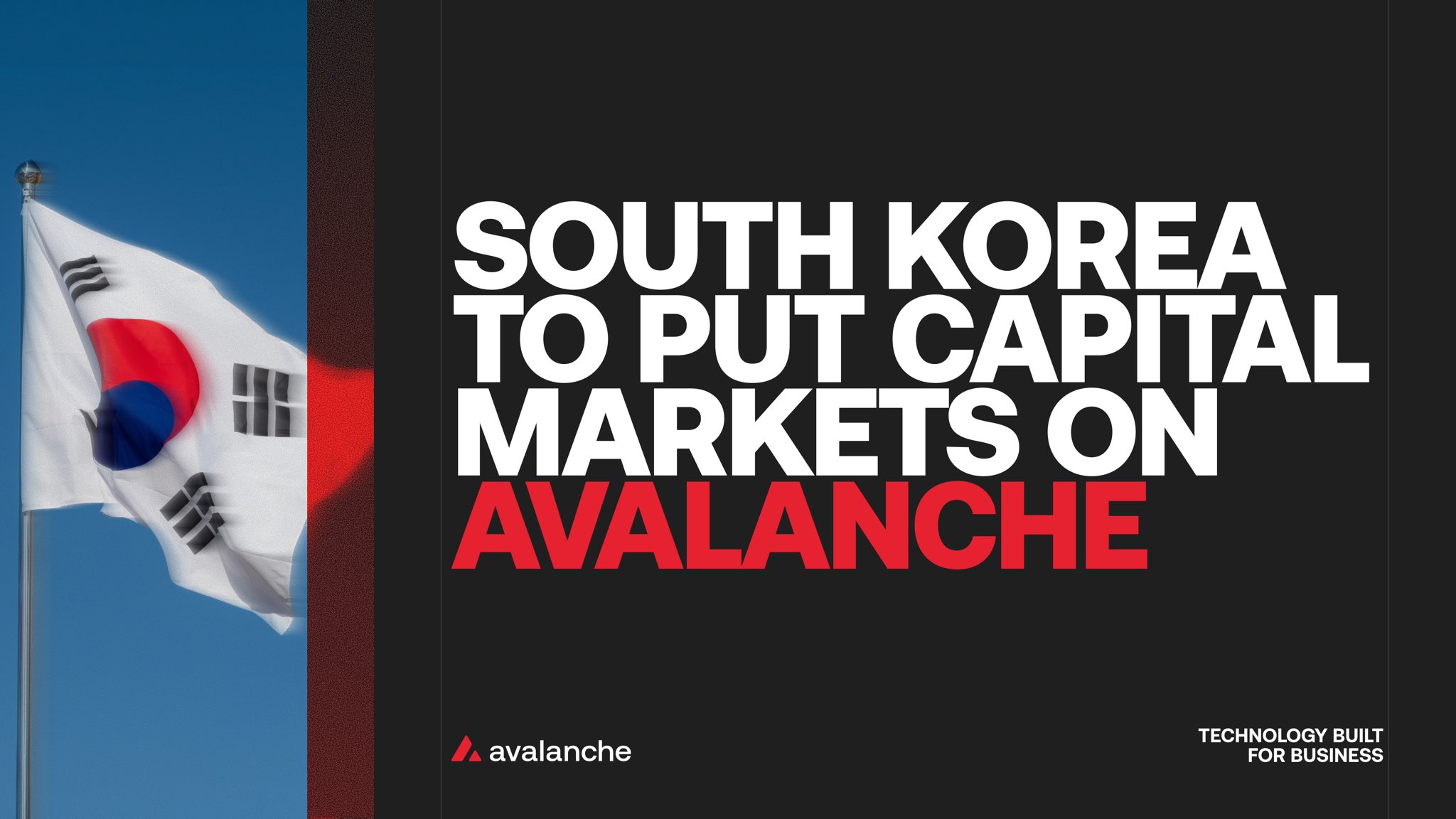
South Korea's Financial Services Commission (FSC) and the Korea Securities Depository (KSD) published a three-phase roadmap on Sept. 4, 2026, to bring tokenized stocks, bonds and funds into the country's regulated securities market, according to the FSC's own release as reported by Cointelegraph and Seoul Economic Daily. Hours later, @avax posted that the FSC and KSD "are laying the groundwork to bring stocks, bonds and funds onchain, connecting the full capital markets stack from issuance and trading to clearing, settlement and investor rights," describing the effort as a program "powered by Avalanche." Avalanche Foundation is the only party making that second claim — it does not appear anywhere in the regulator's own policy release.
The roadmap the FSC actually published
The FSC's plan runs in three stages, tied to amendments to South Korea's Act on Electronic Registration of Stocks and Bonds that take effect Feb. 4, 2027, per Cointelegraph. Phase one, starting that date, gives legal recognition to tokenized institutional money-market funds, private corporate bonds, unlisted stocks held under trust structures, and publicly offered fractional-investment securities. Phase two expands tokenization to all publicly offered securities. Phase three targets onchain settlement linked to stablecoins, with timing dependent on separate stablecoin legislation, according to Seoul Economic Daily. The FSC plans to propose amendments to subordinate capital-markets and electronic-securities rules for public comment before the end of September 2026. It is not creating a new license tier for most of the market: existing financial-investment license holders can handle tokenized securities within their current scope, though a new license category is carved out for over-the-counter venues trading debt securities. Retail investors face a 100-million-won annual cap on net purchases at each over-the-counter exchange for the fractional products, per Seoul Economic Daily. Neither report names a blockchain platform for any of this.
Where Avalanche's claim does and doesn't line up
The FSC and KSD's own framework, as described in that coverage, is technology-neutral on its face. Ledger Insights, covering Koscom's KoSTO tokenization platform — which has 12 securities firms signed on and integrates with KSD — reports that KSD is separately building infrastructure meant to reconcile securities issuance data across more than one blockchain. TronWeekly, a crypto-native outlet that also picked up the Avalanche post, flagged the same gap directly: it noted that the FSC's Sept. 4 release confirms the tokenization roadmap itself but does not name Avalanche as the blockchain platform, and that Avalanche's role should be read as the company's own stated involvement rather than a government designation. Descout could not find any FSC, KSD or Korean financial-press statement naming Avalanche in connection with this roadmap. KSD has already named its infrastructure builder: Samsung SDS won the contract to build and operate KSD's tokenized securities platform, running a functional analysis in 2024 and developing a testbed in 2025, and is targeting completion by February 2027 — the same month the FSC's legal framework takes effect — according to the Korea Times. That contract, not Avalanche's post, is the clearest public signal of which vendor KSD is actually building on. Whether the FSC or KSD is running any parallel pilot or evaluation on Avalanche's infrastructure, and how that would sit alongside the Samsung SDS platform or Koscom's multi-firm KoSTO system, is addressed in neither Avalanche's post nor the regulators' own material.
Avalanche's broader push into Korean finance
The Sept. 4 post follows a run of Avalanche-branded announcements about Korean institutions this year. On Aug. 25, @avax said POSCO International — a trading arm of Korea's largest steelmaker, which it described as supplying companies including Hyundai, Samsung, Kia, Toyota, GM, Ford and LG — is "harnessing the power of blockchain technology" for trade and treasury management, "together with Intain and Olea." Descout covered that period of announcements, POSCO included, in Avalanche's Institutional Stretch, Aug 24-Sep 1. Unlike the FSC/KSD claim, the POSCO pilot was reported independently within a day by outlets including Crypto Briefing and Crypto Economy, which detailed how Intain — operating a Layer-1 network built on Avalanche's infrastructure — used AI to reconcile trade documents before Olea, backed by Standard Chartered's SC Ventures, purchased the tokenized receivables with real capital; POSCO ran a similar pilot with LG CNS on Injective in July. The corroboration gap identified in this piece is specific to the FSC/KSD claim, not a pattern across Avalanche's Korea announcements.
What's confirmed, and what isn't
Confirmed, independently: South Korea's securities regulator and its central depository are moving ahead with a real, dated plan to legally recognize tokenized securities, beginning Feb. 4, 2027, with subordinate rules due for public comment this month. Not confirmed by anyone besides Avalanche: that Avalanche is the chain, or a chain, the FSC or KSD will actually use for that program. The two facts collapse into one the moment a headline reads "South Korea puts capital markets on Avalanche" — the FSC's own words describe a policy direction and a legal framework change; a vendor selection is a claim only Avalanche has made. What would settle it is an FSC, KSD or Koscom statement naming Avalanche directly, or documentation of an actual pilot running on Avalanche infrastructure; until one surfaces, the vendor question stays open even as the underlying tokenization timeline is real.