

Avalanche Foundation Spells Out How It Wants AVAX to Capture Value
In a Sept. 3 post, the Avalanche Foundation framed its whole economics agenda around one idea: you can't capture value you haven't measured. Its own numbers show the gap — a $12.7 million monthly income figure against a $3.19 billion AVAX market cap.
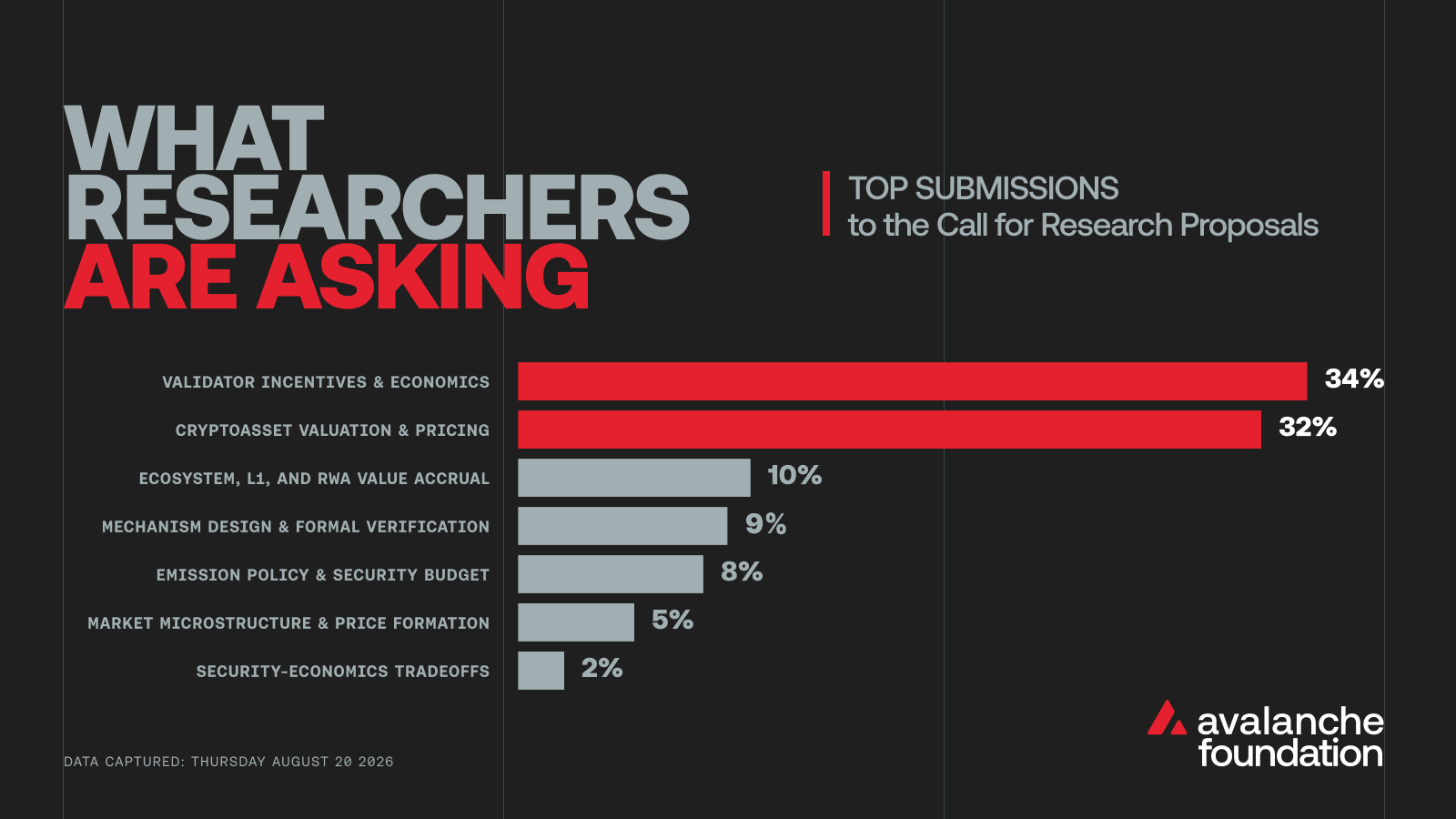
The Avalanche Foundation said on Sept. 3 that it wanted to explain the thinking behind how it plans to make AVAX capture more of the value moving through the network. In a post from @AvalancheFDN, the Foundation compressed the logic to one line, crediting an account it named frostLedger with the framing: "you can't capture value you haven't measured, and you can't distribute value you haven't captured." That sentence is the shorthand for a framework the Foundation has spent 2026 building out in public — Measure, Capture, Distribute — and it now comes with a metric, a funded research program, and one closed program that didn't survive the transition.
What "measure" has produced so far
The clearest deliverable is a metric. On Aug. 12, @avax announced Gross Chain Income (GCI), and an avax.network post under Lead Economist Eric Lu's byline laid out the mechanics: "Where GCP measures production, GCI measures income, including income that originates outside the on-chain economy but flows to people and balances inside it." The framework nests three numbers — Gross Chain Product (GCP) itself; nominal GCI, which adds "holder yield" earned off-chain; and GCI-general, which further adds the reserve income stablecoin issuers earn on their backing assets.
The post's own numbers show how small the measured economy still is next to AVAX. For June 2026 — the latest full month — it reports $3.1 million in on-chain production (NGCP), $2.7 million in holder yield, and $6.9 million in issuer reserve income — a combined $12.7 million NGCI-general for that single month. Over the full history through June 2026, the cumulative totals were roughly $954.8 million in NGCP, $32.3 million in holder yield, and $242.8 million in issuer reserve income. Annualizing the June run rate puts NGCI-general at roughly $152 million a year — against an AVAX market cap of about $3.19 billion as of Sept. 5, 2026, per CoinGecko. Only a sliver of that flows back through the protocol today: the same post says the C-Chain has burned about $23.5 million in fees since the start of 2024, when the income layers switched on, and that the latest month's burn equaled near 3% of monthly NGCP. GCP and GCI are measurement tools, not a treasury mechanism, and the Foundation has not published a capture mechanism yet.
In an Aug. 17 interview with Team1, Lu said the sequencing is deliberate: "we cannot capture anything until we know how much value there is and where it is; and we cannot distribute any value if we haven't already captured any value." On where captured value would come from, he said the Foundation would "always explore voluntary value capture first, which we believe is mutually beneficial for the protocol and the source of revenue, and the only sustainable mechanism in the long term" — ahead of fees, MEV profit or app revenue, without ruling those out.
Why this is landing now, not as pure theory
The framework answers a specific, dated problem. An Aug. 20 report from criptolog on Avalanche's on-chain activity found the C-Chain processed a record 235.6 million transactions in the second quarter of 2026 — a seventh consecutive quarter of growth — while AVAX traded down more than 70% year-over-year over the same period, a divergence the report partly ties to the Etna upgrade, which cut base transaction fees roughly 96% and shrank the AVAX burned per transaction. More usage was not showing up in AVAX's price or in fees actually captured by the protocol — which is the exact gap Lu described as the reason for the whole agenda.
The research pipeline: numbers that don't quite match
The Foundation is paying outside academics to work on the "capture" half of the problem. Its Call for Research Proposals offers grants of up to $50,000, paid in three installments over 12 months, across two tracks: cryptoasset pricing and valuation, and validator economics and network security. A six-person committee reviews submissions — Ava Labs CEO Emin Gün Sirer, Foundation Chief Investment Officer Matias A., Lu, and three outside academics, Duke's Campbell Harvey, the University of Florida's Fahad Saleh, and Columbia's Agostino Capponi.
The application counts the Foundation has given out don't fully agree, and each is worth reading with its date attached. On Aug. 7, it said it had received "over 150+ applications" and completed an initial screen. By Aug. 31, it said "over 160 proposals" had been submitted, with "approximately 95" advancing to committee — broken down by topic as 34% validator incentives and economics, 32% cryptoasset valuation and pricing, and 10% ecosystem/L1/RWA value accrual. Lu, in the Aug. 17 interview, separately put the total at "close to 200 submissions." The numbers aren't contradictory — one is a floor, the other a rounder estimate — but the Foundation hasn't reconciled them, or said whether or when any proposal will be funded.
Retro9000 closed the same month this framework went public
The Foundation's other major economics-adjacent program moved the opposite direction: it ended. On Aug. 20, the same day as the GCI-adjacent posting cadence, the Foundation said Retro9000 — its retroactive-funding program — had closed new applications "following the final disbursement of funding from its final rounds." Retro9000 launched in November 2024 with a stated $40 million cap; an Aug. 2025 avax.network status post put participation at 195 projects to that point, with the program's first snapshot round drawing more than 1.3 million unique voters.
Two weeks before the close, on Aug. 6, the Foundation posted what it called an honest reflection on Retro9000, credited to program managers named Dorlanz0x and memosthetic, saying the program "gave us real, at-scale data on retroactive funding" and promising an account of "what worked, what didn't." What that account concludes, what Retro9000 paid out across all of its rounds in total, and whether anything succeeds it as a distribution mechanism under Measure-Capture-Distribute, remain open questions.
The unsettled step: distribution, and the inflation fight sitting next to it
Capture and distribution are where the framework is least concrete, and where the most public disagreement sits. Lu said "the distribution policy is ultimately a delicate balance of these different channels," pointing to burns and validator-directed revenue as the mechanisms in play without committing the Foundation to a fixed rule.
That ambiguity sits next to an active argument about how validators get paid at all. Avalanche validators are currently rewarded through new AVAX issuance, not fee revenue — C-Chain fees are burned, not distributed. Crypto Briefing reported Aug. 27 that Foundation economists are discussing a longer-term shift toward "a reward mechanism tied to the value the protocol captures rather than to token emission schedules" — paying validators from fees instead of newly minted AVAX. That is a reported direction of discussion, not a Foundation proposal on the record, and the Foundation's own writing is more cautious about it: a July 2 avax.network post on pending Avalanche Community Proposals calls a fee-funded security budget unresolved: "a security budget drawn from a finite pool declines by construction, and the assumption that fee revenue arrives in time to take its place is, today, still an assumption." The one item currently in community discussion, ACP-285, is narrower: it lowers the minimum staking-reward floor from 10% to 7.5%, trimming annual AVAX issuance by an estimated 0.5 to 1 percentage point while leaving the maximum reward rate unchanged.
What would tell you this is more than a research agenda
Three things, each checkable on a date:
- Whether the Foundation names any funded Call for Research Proposals grantees, and when — nearly 95 proposals had reached committee review as of Aug. 31, with no funding announcement yet.
- Whether ACP-285, or any successor community proposal, actually activates on Avalanche's C-Chain, and separately, whether the Foundation or Ava Labs puts forward an ACP that redirects fee revenue toward validators instead of burning it — the specific step that would move "capture" from research framing into code.
- Whether the Foundation publishes GCP/GCI figures on an ongoing basis rather than the single backward-looking window it has published through June 2026. A one-time historical accounting is a research paper; a running series is a metric the Foundation intends to be judged against.
Until one of those happens, Measure-Capture-Distribute is a framework with a metric attached to it, a fully subscribed research program, and a retroactive-grants program that just ended.