

Base Ships Azul and Beryl Under the Base Stack; Cobalt Due in September
Base said Aug. 3 it has shipped two protocol upgrades since moving off shared OP Stack clients onto its own Base Stack: Azul in May, Beryl in June, with Cobalt due in September.
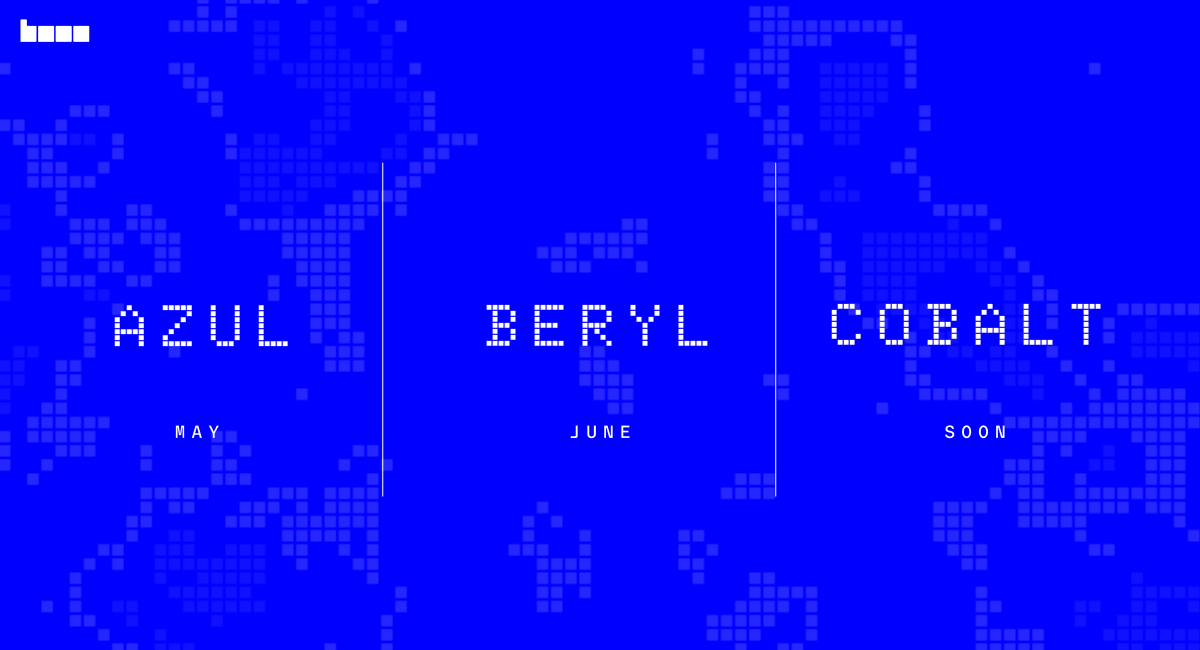
Base said Aug. 3 that it has shipped two protocol upgrades since moving off the client software it shared with the rest of the OP Stack onto its own Base Stack. Azul went live in May, Beryl followed in June, and a third upgrade, codenamed Cobalt, is scheduled for September — the cadence Base laid out in a roadmap graphic posted with the announcement.
What Azul changed in May
Base's upgrade specs put Azul's mainnet activation at May 28, 2026, 18:00 UTC. Before Azul, the network ran op-node for consensus and op-geth or op-reth for execution — the same client software the rest of the OP Stack uses. The specs say Azul ended that: only Base's own base-reth-node and base-consensus clients support the network from Azul onward, and operators on the old clients had to migrate before the hardfork activated.
Azul's other headline change is a new multiproof withdrawal system. A Trusted Execution Environment (TEE) proof and a zero-knowledge (ZK) proof can each independently attest that funds are safe to leave the chain, and per Base's engineering blog, when both agree, a withdrawal from Base to Ethereum can finalize in as little as one day. That fast path runs alongside the network's existing dispute window, which stood at seven days going into Azul, according to Base's Beryl specs. Azul also moved Base's execution layer onto Ethereum's Osaka upgrade, per the Azul specs.
What Beryl changed in June
Beryl activated on mainnet June 25, 2026, at 18:00 UTC. It shortened that seven-day dispute window to five days for standard withdrawals — the one-day dual-proof fast path Azul introduced is unchanged — and it shipped B20, Base's specs say, a native token standard "implemented as Rust precompiles" rather than ordinary smart contracts, aimed at stablecoin, real-world-asset, and long-tail token issuers while staying ERC-20-compatible. Base's engineering blog describes two B20 variants at launch: a general-purpose "Asset" type with configurable decimals and rebasing, and a fixed six-decimal "Stablecoin" type for fiat-backed tokens.
Beryl also swapped in Reth V2, a rebuilt execution client that Base's specs say cuts node disk usage by up to 50% and lifts throughput roughly 33% through a rewritten state-root pipeline. The same specs note that native account abstraction — the feature Cobalt is set to carry — was already "previewing on the vibenet devnet" as of Beryl's release.
What Cobalt is set to bring in September
Base has not published a specs page for Cobalt, and its Aug. 3 post names September without a specific date. What is confirmed comes from Base's own developer network: Vibenet, described as "an ephemeral Base developer network for testing in-flight features," says the account-abstraction features it hosts today are "coming soon in Base Cobalt" — multiple signature schemes (secp256k1, P-256, WebAuthn passkeys), account portability across EVM chains, key rotation without changing addresses, session keys, sponsored gas payments, and atomic batch transactions.
Those features come from EIP-8130, a draft Ethereum proposal filed in October 2025 by a Base/Coinbase engineer and developed in Base's own GitHub organization; the reference implementation itself warns it "has not been audited" and should not be used in production. Base's Beryl specs describe the same account-abstraction work as arriving in "a later Beryl phase" rather than naming Cobalt specifically — Base has not reconciled the two descriptions, so which release formally ships native account abstraction on mainnet is not yet confirmed.