

Aave V4's Hub-and-Spoke Design on Avalanche, and Its Planned RWA Market
Aave V4 splits each network’s liquidity into one shared Hub and purpose-built Spokes — on Avalanche that’s a Main, AVAX Correlated, and Forex market live since July 15, 2026, plus a planned RWA collateral market for institutional borrowers.
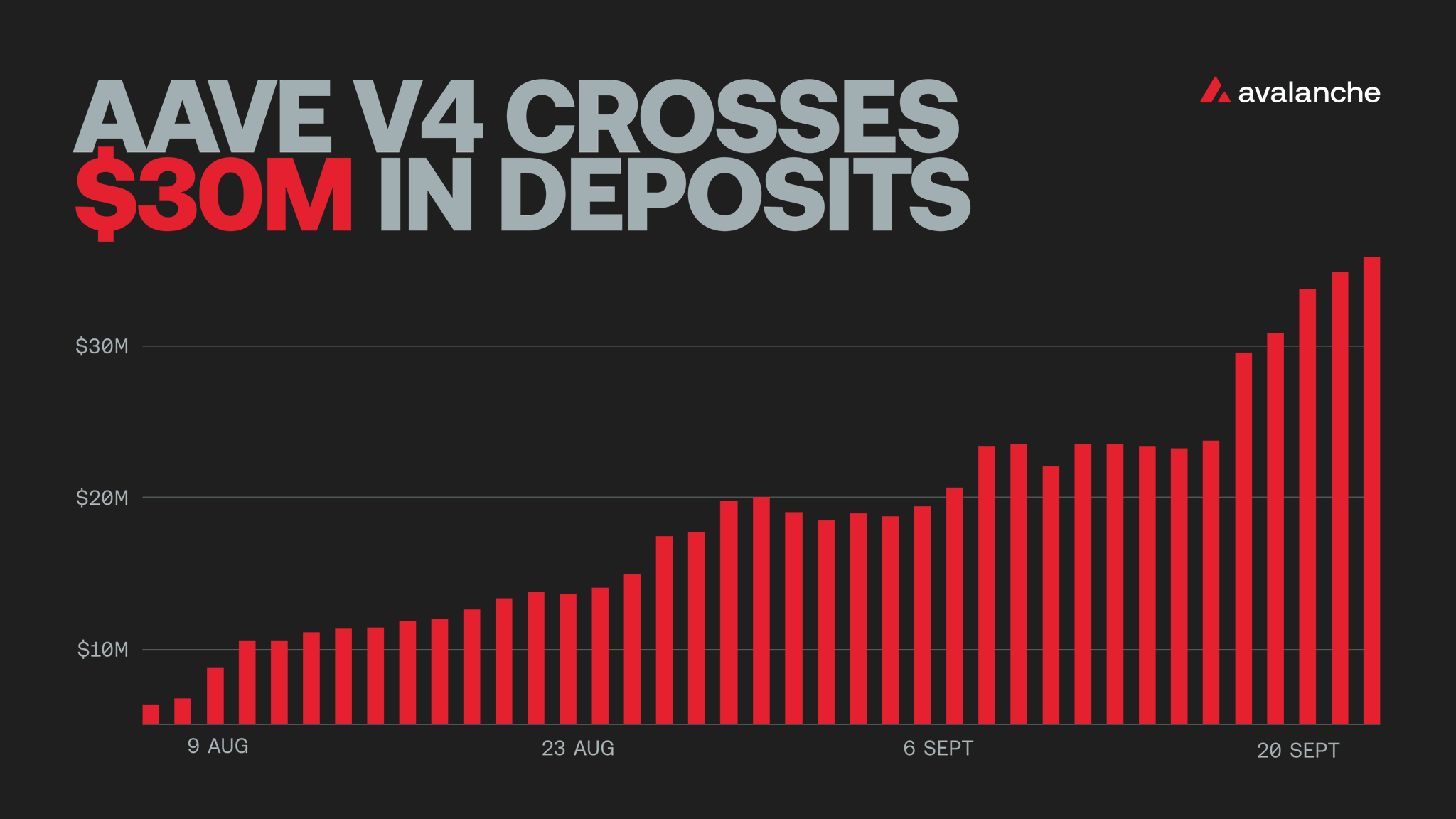
Aave V4 replaces V3's siloed markets with a hub-and-spoke structure: one shared Liquidity Hub per network holds the deposited assets, and separate Spokes connect to that Hub to offer specific lending and borrowing products, each with its own rules and risk settings (Aave). Aave deployed V4 on Avalanche on July 15, 2026 — its first V4 deployment outside Ethereum, following Aave V2 (2021) and V3 (2022) on the same network (Aave). Aave CEO Stani Kulechov said Avalanche was chosen as the first expansion network for V4, citing its onchain-finance community and institutional interest in the chain's technology (Avalanche). Aave has since extended V4 to additional networks: on September 25, 2026, Aave Labs launched an Equities Hub on Base that lets eligible non-U.S. users post seven Coinbase-issued tokenized stocks as collateral to borrow USDC (Aave). This guide covers the Avalanche deployment specifically.
How the Hub and Spokes work
The Hub is the accounting and liquidity layer. Assets aren't parked in any single market; instead, "all assets are stored in a unified Liquidity Hub per network," and the Hub "tracks which Spokes are authorized to access which assets and enforces limits on how much liquidity each Spoke can draw" (Aave). A Spoke gets a credit line to borrow from the Hub and a debit line to supply into it (Aave; Aave), and handles its own user positions, collateral tracking, and price oracles (Aave). Because each Spoke keeps independent accounting, governance can add or upgrade one "without disrupting the rest of the system" — Aave's own description says "anyone can build a Spoke," which then taps the Hub for a liquidity credit line up to a cap the Hub sets (Aave).
On Avalanche, that structure is one Core Liquidity Hub feeding three live Spokes:
- Main market — general-purpose lending and borrowing. The Hub holds WAVAX, sAVAX, BTC.b, USDC, USDT, WETH.e, and EURC; the Main market lets users supply WAVAX, BTC.b, USDC, USDT, or WETH.e and borrow USDC, USDT, EURC, WAVAX, BTC.b, or WETH.e (Aave).
- AVAX Correlated market — built for liquid-staking strategies. Users can supply sAVAX at a 95 percent collateral factor and borrow only WAVAX (Aave).
- Forex market — for trading and hedging fiat-pegged stablecoins, where EURC, USDC, and USDT each serve as collateral (Aave).
All three draw from the same Core Liquidity Hub rather than fragmenting liquidity across separate pools (Aave).
How risk stays contained
Risk isolation is structural, not just a caps table. Each Spoke's own rules and risk settings sit apart from the Hub's system-wide accounting, and the Hub authorizes — and caps — exactly which assets a given Spoke can draw (Aave). Aave applies the same logic to a higher-risk listing: "Isolation Mode can be implemented as a dedicated Spoke with its own parameters and access controls, while still drawing from the shared liquidity in the Hub" — the Hub sets limits on how much liquidity each Spoke can draw (Aave). Aave's own architecture writeups do not spell out what happens to the Hub's shared liquidity if a Spoke's losses exceed its cap — that mechanic is not published, so it stays an open question rather than something reconstructed here.
The planned RWA collateral market
On September 16, 2026, Aave Labs announced an RWA Hub coming to the Avalanche deployment: a dedicated credit market where eligible institutions post tokenized real-world assets as collateral and borrow against them without selling the underlying position (Crypto.news; CryptoBriefing). Kulechov said the new market is intended to move tokenized assets beyond issuance and let institutions use them directly as collateral in credit markets, according to CryptoBriefing (CryptoBriefing). The market would use the same Hub-and-Spoke split as the rest of the deployment — its own collateral rules and risk parameters, while still drawing from the shared liquidity (CryptoBriefing). USA₮, the dollar stablecoin issued by federally chartered Anchorage Digital Bank with Tether's backing, is planned as the market's initial borrowable asset (Crypto.news). Aave has named the asset classes it could eventually support — tokenized Treasuries, money market funds, private credit, real estate, and corporate bonds — but has not named the specific first collateral assets or a launch date (Crypto.news; CryptoBriefing).
For a sense of how Aave structures RWA collateral once a market like this is live, its existing Horizon market offers a working pattern, though it runs on different infrastructure: Horizon is a separate deployment, live since August 26, 2025, that predates V4's Hub-and-Spoke design (Aave). On Horizon, each RWA issuer — Superstate, Centrifuge, and (soon) Circle, at launch — controls its own investor allowlist and KYC, while the protocol itself stays permissionless: "any wallet holding an approved token can supply it as collateral," and only stablecoins (GHO, RLUSD, USDC) are borrowable against that collateral, with independent risk provider LlamaRisk setting the per-asset loan-to-value, liquidation threshold, and supply/borrow caps (Aave; Aave). Whether the Avalanche RWA Hub reuses Horizon's issuer-controlled compliance model, or a different one built around V4's Spoke design, has not been published.
What's not live yet
The RWA Hub itself is not live. Aave has confirmed the plan and named USA₮ as the intended first borrowable asset, but has not named the first collateral assets, the market's risk parameters, or a launch date.
Sources
- Aave — Aave V4 Launches on Avalanche — launch date, Core Liquidity Hub composition, the three Spoke markets and their collateral/borrow rules.
- Aave — Understanding Aave V4's Architecture — Hub/Spoke definitions, credit-line mechanism, governance adding new Spokes.
- Aave — How Aave V4 Handles Risk Isolation — risk isolation between Spokes, the Isolation Spoke mechanic.
- Aave V4 Overview docs — corroborating Hub/Spoke technical description.
- Aave — Aave Horizon Launches — existing RWA collateral product: accepted assets, borrowable stablecoins, launch date.
- Aave — How Aave Horizon Is Built to Support Institutions — issuer-controlled compliance, LlamaRisk parameter-setting.
- Crypto.news — Aave plans Avalanche RWA hub with Tether's USA₮ — RWA Hub announcement, Anchorage/Tether roles, unresolved collateral list and date.
- CryptoBriefing — Aave plans RWA Hub on Avalanche with USA₮ support — corroborating facts on the RWA Hub plan and its stated purpose.